





OPEN HARDWARE · OPEN FIRMWARE

The Project.

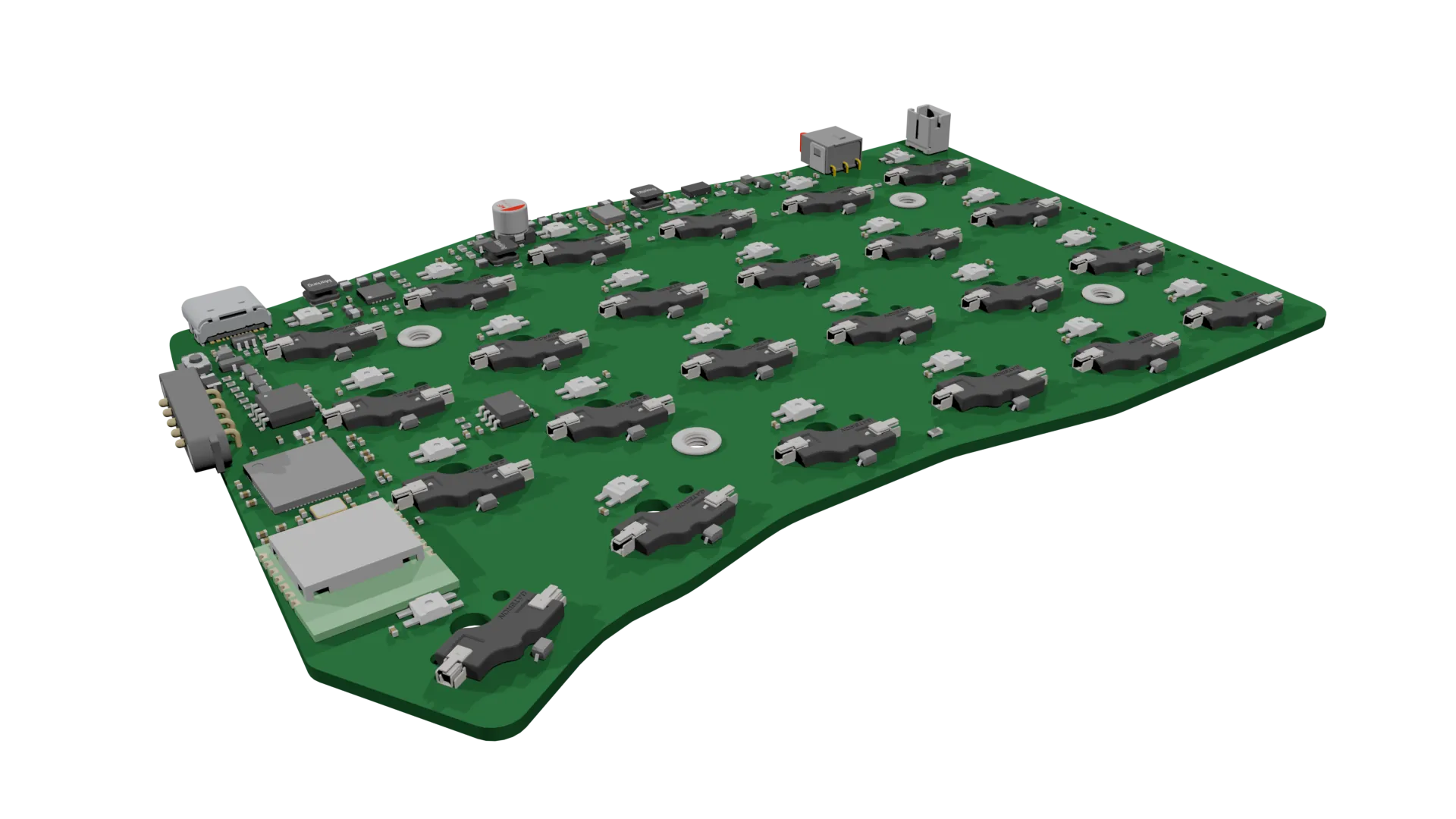
Everything that goes into a Keeeyboard-Split
Schematics, board files, source code, STLs.
Take it, fork it, build your own.

Keeeyboard project hero

Files & links

Build log

From idea to Prototype.

KeeeyBoard-Split
2026-04 late
  • Add 3-pin magnetic connector for dual-half recharging.
  • Migrate to 5-pin magnetic connector to support external Add-Ons.
  • Apply rubber pads to the case for grip and vibration damping.
  • Revise and upgrade the mechanical case.
  • Finalize PCB designs.
  • Order components and kick off first PCB batch.
Mockup
2026-04 early
  • Build a split prototype to validate the full functional stack.
  • Integrate hardware on/off switch.
  • Add USB-C connectivity.
  • Implement battery recharging over USB.
  • Install RGB LEDs on the prototype.
  • Confirm BLE as the required wireless communication method.
  • Design case with hot-swap support for both low-profile and standard switches.
  • 3D-print the mechanical case.
  • First working mockup complete.
CMK
2026-03
  • Start firmware rewrite with QMK-inspired features.
  • Rewrite core event loop and BLE manager from scratch.
  • Adopt stack: PicoSDK + FreeRTOS + BTStack + CYW43 + TinyUSB.
  • BLE chain supports up to 3 output devices and 1 input device.
  • Add HID reports for keyboard and mouse.
  • Test with BLE-Mouse and 2× BLE-3×3-Keyboard. Everything works.
  • Firmware complete. Hardware still missing.
Exploring
2026-02 late
  • Open direction toward a full custom mechanical keyboard.
  • Add EEPROM manager and test with external I2C EEPROM.
  • Implement addressable RGB LED support via PIO.
  • Test with an LED strip. Works correctly.
  • Research the existing custom keyboard market.
  • Evaluate QMK firmware. Not compatible with RP2350, discarded.
Improvement
2026-02 early
  • Prototype is stable and fully working.
  • Add BLE single-connection support.
  • Implement HID reports for joystick and keyboard.
Key-Pad 3x3
2026-01 late
  • Design a 3x3 keypad on Raspberry Pi Pico 2W.
  • 3D-print the case.
  • Data via micro-USB only (temporary).
  • Add LED status indicators.
  • Integrate a general on/off switch.
  • Device runs on USB power when connected, AAA batteries otherwise.
  • Implement a custom HID report.
The idea
2026-01 early
  • Identify the need: a dedicated device for sounds and macros.
  • Define requirements: mechanical switches for tactile feedback.
  • Device must be portable, expandable, and compact.
  • Choose a low-cost, easy-to-flash approach.